
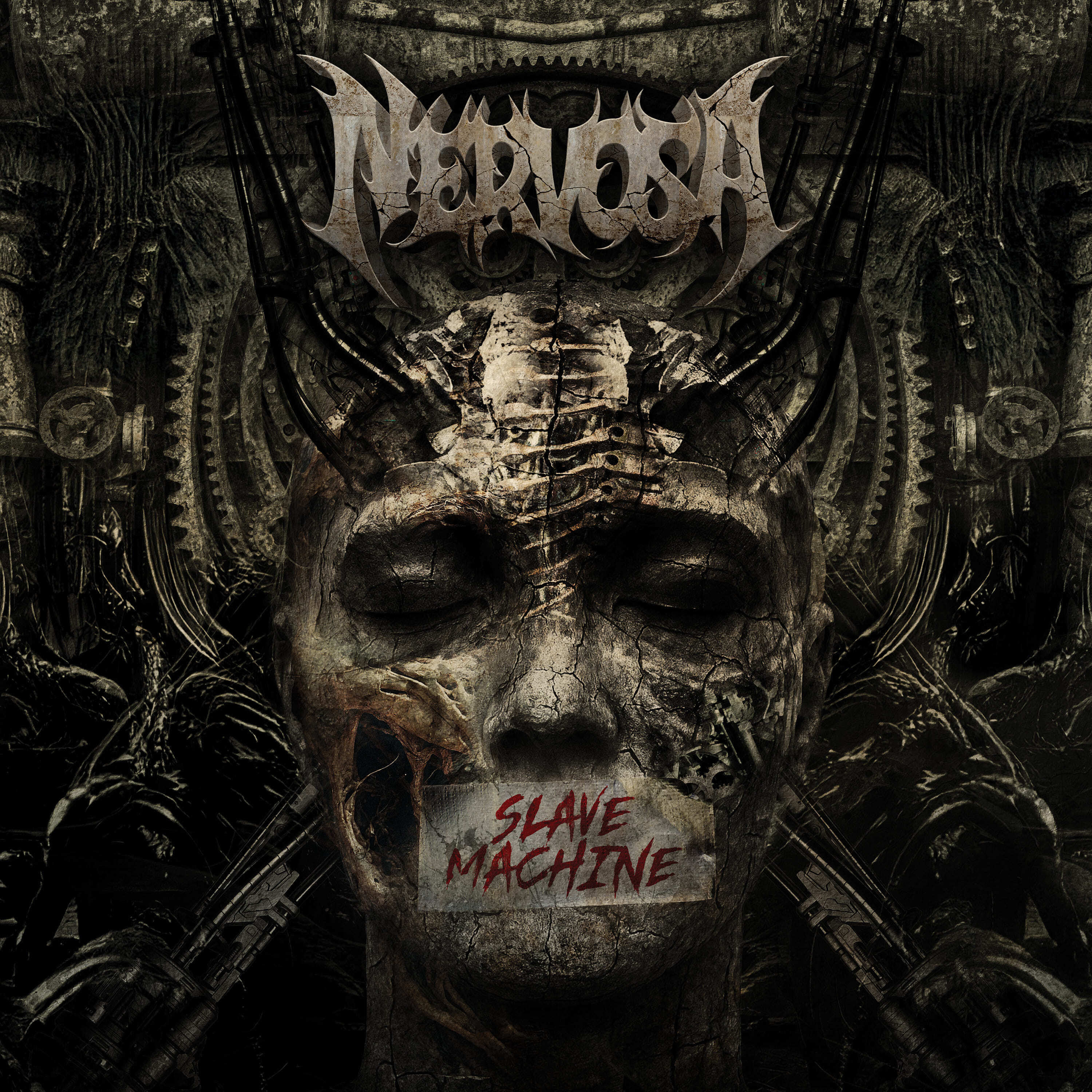
NERVOSA
‘Slave Machine’
Napalm Records
There’s a very specific world that NERVOSA builds across Slave Machine, and it never really loosens its grip once the record starts. This album feels like the last stretch of civilization before the lights finally go out. Steel skeletons of buildings stand half-buried in dust. Smoke drifts across a skyline that no longer belongs to anyone. Sirens wail somewhere in the distance, but no one answers. The air is thick with unrest, political fracture, and the low hum of a society still moving even though its heart has already stopped. That atmosphere runs through the entire record; control, blind obedience, war, addiction, collapse; all feeding the sense that the world is still standing, but just barely!
“Impending Doom,” is where that picture first comes into focus. The ominous, almost tribal chanting in the intro feels like distant voices echoing through the ruins before the band tears into the heavier riffs. It’s a strong opening, one that builds dread before finally dropping the hammer around the two-minute mark. That riff finally gives you the weight the title promises. It feels like concrete splitting under pressure, the moment the cracks become impossible to ignore. Still, even with that excellent setup, the chorus never fully hooks the way it seems intended to. It starts strong, but the payoff isn’t quite there. “Slave Machine,” immediately follows by doing what this band does best, straight into razor-sharp guitar work and a perfectly timed scream that cuts through like a warning alarm. This track is a ripper from start to finish. The galloping guitar work before the chorus is one of the first real standout moments, giving the song that relentless forward charge that keeps your neck moving whether you want it to or not.
“Ghost Notes,” sinks the album into a darker and more claustrophobic place. The riff structure has that dense, mechanical pulse that immediately pulls you in, almost hypnotic in its repetition. Midway through, the bass work adds real depth and atmosphere, thickening the darkness before the song shifts gears for a solo. The solo itself is excellent, but this is where the record starts showing one of its biggest weaknesses. Too often, the tempo changes feel designed to spotlight the lead section rather than serve the flow of the song. Here, the groove had already done the hard work of getting its hooks into you, and the shift interrupts that momentum. “Beast of Burden,” follows and it never really comes together. It feels like the band is trying to reach back toward an older death metal darkness while still carrying their modern groove-heavy sound, but it never shapes into anything I’d want to revisit. The lyrics feel stale, and the song drifts by without leaving much behind.
Thankfully, “You Are Not a Hero,” pulls the record back into focus. This is one of the strongest songs on the album! The riff writing is thick and punishing and keeps your head moving even while trying to write down thoughts. Revisiting it only reinforced how much stronger this one feels. More importantly, this is one of the few moments where the band lets the tempo shifts work naturally. The aggression remains intact from intro to finish, and the solo arrives without tearing the song apart to make room for it. You can hear the influence of so many classic death metal bands in the DNA of this track, but it still feels distinctly theirs. “Hate,” comes in crushing right out of the gates. The verses and especially the pre-chorus are punishing, building real tension, but once again the jump into the chorus feels too dramatic. The momentum gets broken by a shift that pulls away from the violence the song had already established.
By the time “The New Empire,” and “30 Seconds,” arrive, the album starts to show signs of fatigue. There are strong pieces, great double bass work, solid chugging riffs, flashes of atmosphere but neither song ever fully reveals itself. “The New Empire,” especially feels trapped in the same structural loop as earlier tracks, while “30 Seconds,” takes too long to get going and never fully lands even once it does. They’re not bad songs, but they don’t leave scars.

“Crawl for Your Pride,” drags the record back toward its strengths. This is where the riffs and chugs return with real force. The intro and verse sections are excellent, a reminder that when this band leans into raw aggression, they can absolutely deliver. But once again, the shift from pre-chorus to chorus is too abrupt, breaking the headbanging rhythm that had already been established. “Learn or Repeat,” finally gets those tempo changes right, and the flow is much smoother, but by this point in the album I should be expecting more than simply hoping momentum carries the track forward. This deep into the record, the songs need identity, not just movement.
Then comes “The Call,” and this is easily one of the best songs on the album. The riffs hit with purpose, the pacing is finally right, and the song carries enough identity to separate itself from the rest of the pack. It feels focused, confident, and fully realized. Which makes “Speak in Fire,” all the more frustrating as a closer. The intro is exactly what I wanted; give me that opening guitar work, give me that energy. For a moment, it feels like the record is finally about to close with the fire it promises. But once again, the individual pieces never fully become a whole. The instrumentation is excellent, but it doesn’t bring the album together as a closing statement, and it left me feeling a little let down.
That’s where Slave Machine ultimately lands for me. The world it creates is vivid ashen skies, collapsing systems, and people still marching through the wreckage because they no longer know another way. The musicianship from Prika Amaral, Helena Kotina, Hel Pyre, Emmelie Herwegh, and Michaela Naydenova is never in question. These women are exceptional musicians, and you can hear it all over this record. The saving grace here is the playing. The frustration lies in the songwriting choices. Too many tempo changes move in the wrong direction, and the sharp distinctions between verse, pre-chorus, and chorus become impossible not to notice.
At roughly 45 minutes, the album also starts to feel longer than it needs to be. With nearly every track hovering around the four-minute mark, some of the mid-to-late record material begins to blur together and weigh down the overall experience. There is a stronger, tighter album buried in here, and for me the sweet spot would have been 8 or 9 songs. Trim a few of the tracks that don’t fully reveal themselves, and the stronger moments hit with far more force.
There is a lot to admire in this wasteland of a record, but just as much that keeps it from becoming something greater.
3.0 Out Of 5.0 Battle Jackets.
Leave a Reply
You must be logged in to post a comment.