
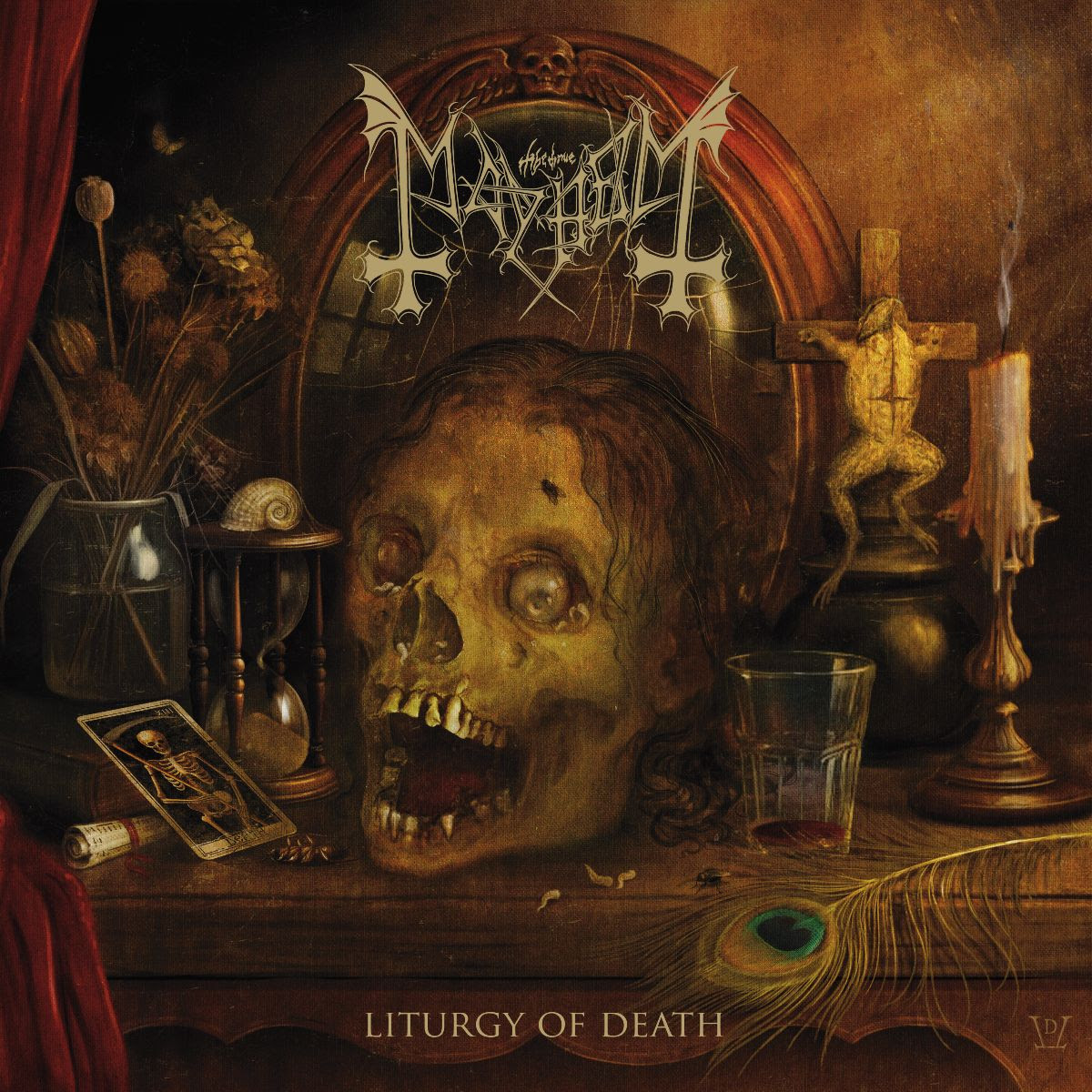
MAYHEM
‘Liturgy Of Death’
Century Media Records
Over the past decade or so, once – and often – tumultuous Norwegian black metal icons MAYHEM have somehow become a model of stability. The 40-plus-year-old band’s current lineup of vocalist Attila Csihar, founding bassist Jørn “Necrobutcher” Stubberud, long-time drummer Jan Axel “Hellhammer” Blomberg and “new” guitarists Morten Bergeton “Teloch” Iversen and Charlie “Ghul” Hedger has been together since 2012.
And since taking over as the primary songwriter when he came aboard in 2011, Teloch seems to have grown comfortable, or at least more confident and focused, in that role as time has passed, especially as Ghulbegan contributing compositions of his own to lend a second perspective. All this certainly pays off on MAYHEM’s seventh and latest studio full-length ‘Liturgy Of Death.’
Where 2014’s ‘Esoteric Warfare’ embraced the avant garde and was at times just plain weird, and 2019’s ‘Daemon’ harked back to the classic black metal of the band’s infamous 1994 debut ‘De Mysteriis Dom Sathanas’ and was far more straight-forward, ‘Liturgy Of Death’ lands somewhere in the middle. And in this case, that’s a best of both worlds proposition.
The new album is a masterful amalgam of progressive sprawl and oddball turns complemented by raw black metal pummel and conviction. The funereal opening to “Ephemeral Eternity” would seem to portend the gloom inherent in the album’s prevailing themes of mortality, the frailty of human existence and the inevitability of death, or, per “Weep For Nothing,” “a common end for every mortal soul.” These are, as you may well know, subjects with which MAYHEM is all too familiar – one-time frontman Per Yngve “Dead” Ohlin having killed himself in 1991 and founding guitarist Øystein “Euronymous” Aarseth being murdered in 1993.

But after its initially ominous drum rolls and synths, “Ephemeral Eternity” blasts off and the album is a veritable juggernaut, with a variety of twists and turns, the rest of the way. Driven by Hellhammer’s locomotive drumming, Teloch and Ghul deliver wave after wave of riffs – alternating between frantic trems and surging grooves – with workman-like precision buoyed by pure vehemence, leaving little room for mournfulness.
‘Liturgy’ is MAYHEM’s most consistently heavy and downright feral album since 2004’s ‘Chimera,” taking the old school sensibilities of ‘Daemon,’ ratcheting up the intensity and giving it all a contemporary punch that connects with every blow. Despite their relative length, averaging over 6 minutes each, the eight tracks here rarely lose momentum for very long. The martial pace and hushed vocals of “Funeral Of Existence” or the industrial bass drop of “Realm Of Endless Misery” give way to the breakneck bursts that rule the day – with both featuring particularly violent finishes.
Since his return in 2004, MAYHEM’s music has typically turned on the whims of Csihar’s uniquely unorthodox vocals. Here, his operatic warbling, haunting drone, froggy, phlegmatic croaks and at times ritualistic delivery are used more sparingly, but still to great effect on “Despair,” “Weep For Nothing,”etc., as his full-throated screams and roars take the ferocity of the material to another level. Yet the eloquence of his cold-blooded musings remains, as on the album’s stunning closer “The Sentence of Absolution:” “Human life is merely, a point in eternal time / What is the use of prolonging, what barely exceeds nothingness.” So much for “life is good” sloganeering.
And with its creepy chirping guitar flourishes and rare solos, and tribal drums and chants that come out of nowhere to culminate things with a ‘Roots’-era SEPULTURA-like turn, “Absolution” again showcases Mayhem’s unpredictability in dramatic fashion.
The band long ago could have given up the ghost or become a nostalgia act living off the notoriety of ‘De Mysteriis Dom Sathanas.’ Instead, with ‘Liturgy Of Death,” MAYHEM proves that it remains not only a vital force on the black metal playing field it helped bring to prominence – in spite, or because, of its long and checkered history – but one that continues to raise the bar and push the envelope.
4.5/5.0